
Reads your machines, whatever they speak.
Turns machine signals into numbers people can act on: output, downtime, speed losses, quality stops. Derived values you define once, such as an availability figure or what counts as running, are calculated for you and kept alongside the raw data. It runs on a small appliance in the plant, so it keeps recording when the network does not.
In daily production across multi-site manufacturing groups100+
Machine interfaces in the box
1
Appliance per plant
24/7
Recording, network or not
0
Internet connections required
The problem it removes
The machines already know. Nobody else does.
The data exists inside the controllers and the sensors on the line. Getting it out means a different approach for every machine generation, and what usually happens instead is a clipboard, a whiteboard and a number that arrives a day late. This closes that gap without replacing the machines.
Six ways into a machine, in the box
OPC-UA for the modern lines, Siemens S7 for the controllers, ADAM modules for the sensors on older cells, REST for the gateways that already publish, plain TCP for equipment that speaks only its own protocol, and a watched folder for lines that can only write a file.
The numbers, not the raw tags
A raw tag is not something anybody can act on. You define once what availability means on this line, or what counts as running, and the value is calculated for you and stored next to the signal it came from. Everyone downstream reads the same definition.
It keeps recording when the network does not
The recording happens in the plant, on the plant’s own hardware. A link to headquarters going down costs you a delayed report, not a hole in the shift record.
A plant is online in an afternoon
One appliance, one installation, and the collection, the storage and the dashboards come up together already wired to each other. Sites with no internet connection at all install exactly the same way.
Dashboards on the day it is installed
Standard line and shift views are there from the start, so the first conversation about the data happens in week one rather than after a reporting project.
Old lines are not left out
The equipment that cannot be modernised this year is usually the equipment losing the most time. A watched folder or a plain socket is often enough to bring it into the same picture as the new line next to it.
What it does
One way in for every generation of machine.
OPC-UA
The modern machines, the standard way
Subscribes to the values that matter and records changes as they happen, which is what most equipment built in the last decade expects.
Siemens S7
Controllers read directly
Reads controller memory directly, without an extra gateway to install in the cell and keep alive.
ADAM modules
The sensors bolted onto older lines
Standard signal and digital inputs from the measurement modules that are already installed on plenty of older cells.
REST
Whatever already publishes
Where a cell gateway or a machine already offers an interface over the network, it is read on a schedule you set.
Plain TCP
Equipment that speaks only its own language
For machines with a proprietary protocol and no driver, the raw connection is read and interpreted according to the description you provide.
Watched folders
Lines that can only write a file
A folder is watched and new rows are read as they land, which is often the shortest route to including a legacy line in the same picture.
End to end
From a signal on the line to a number you can use.
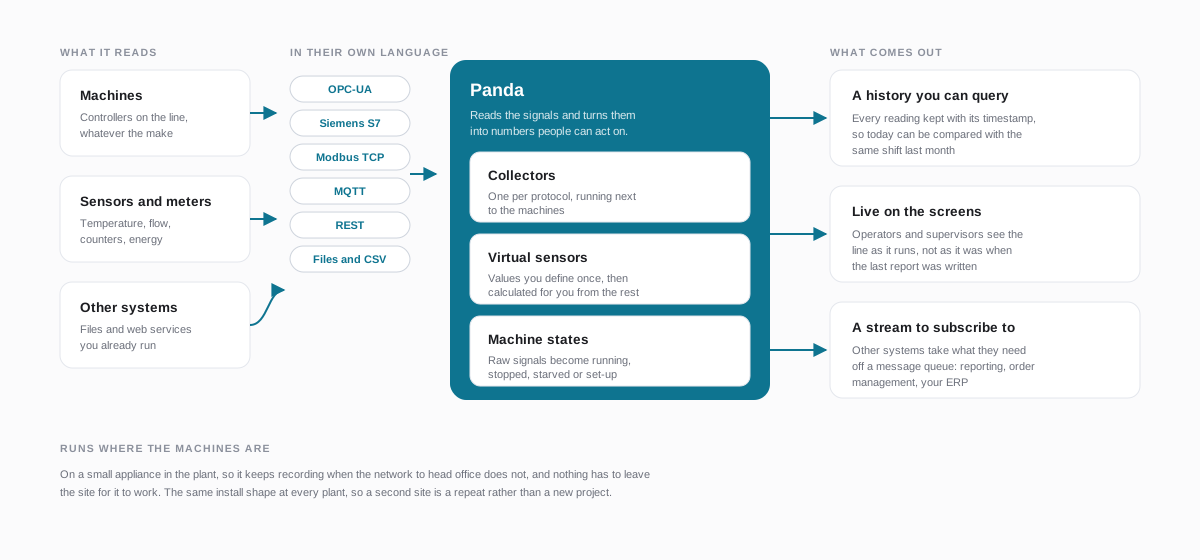
How it runs
One appliance per plant, installed in a single pass, carrying the collection, the storage and the dashboards. It needs nothing from the internet and nothing from headquarters. Sites with their own cluster can run the same software there. Each plant keeps its own certificates and its own address, and rolling out to the next plant is the same procedure again.
Works with the rest of the range
The collection sits between the machine control that produces the events and the order system that turns them into completions and traceability. The same recorded values feed a group reporting cockpit, and an automation can act on a deviation while the shift is still running.
How to start
One line, one week, real numbers.
We connect a single line and let it record for a week. What comes back is normally enough to settle the argument about where the plant is actually losing time.