
Runs a connected production as one system.
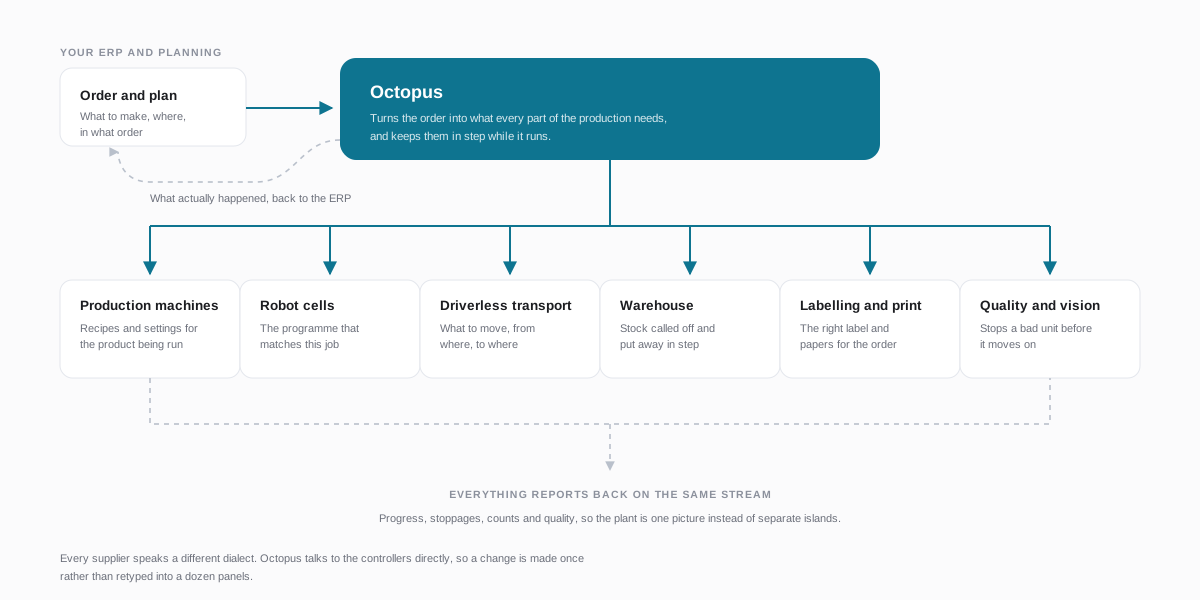
Production machines, robot cells, driverless transport, the warehouse, labelling and print, quality and vision: they come from different suppliers and each speaks its own dialect. Octopus drives them as one system. A change is made once and reaches everything that needs to know, and everything that happens comes back as one stream the rest of the plant can read.
In daily production across multi-site manufacturing groups35+
Machine types supported
10k+
Events a second, in real time
24/7
Continuous line operation
The problem it removes
A hundred machines, a hundred little control problems.
Every machine, cell and vehicle arrived with its own panel, its own idea of what a product change means and its own way of reporting trouble. Each one is a small problem. A few hundred of them is a plant nobody can see. Operators bridge the gaps by hand, and the plant only learns what really happened at the end of the shift. This makes it one thing.
One change, and the whole production follows
A changeover is entered once and everything that needs the new settings receives them, whether that is a machine, a robot cell or the transport that feeds it. No walking the floor with a clipboard, and no half-changed production making scrap because one station was missed.
A profile per plant, not a fork per plant
Every site runs the same software with its own profile: what sits where, how it is addressed, which products apply. A new plant is a new profile, not another version of the product to keep alive.
Talks to the controllers directly
Controllers are addressed directly, Siemens S7 among them, at the speed a cell needs, without an extra gateway sitting in the middle of the floor to be maintained and to fail.
A new machine type does not put the line at risk
Each kind of equipment is a separate module. Adding a robot cell from a new supplier, or upgrading a machine that already runs, does not mean revalidating everything standing next to it.
Everything the line does becomes an event
Start, stop, changeover, reject, speed: all of it goes out on one stream. That stream is what the data collection records and what the order system reads, so the line has one account of itself rather than three.
Screens in the language of the floor
Operator and label screens ship in the languages your plants actually work in, with per-plant branding, so people read instructions in their own language instead of translating in their heads at four in the morning.
What it does
Every corner of the floor covered.
Coordination
The line runs as one unit
One coordinator per site knows the topology of the plant: which lines exist, which machines are on them, how they are addressed and which products they run. Everything else follows from that.
- Line topology described once, per plant
- New machines added without stopping the rest
- Same software everywhere, different profile
Controllers
Direct Siemens S7 communication
Reads and writes controller memory directly, with awareness of racks, slots and product blocks, and reacts to changes rather than polling blindly.
- No extra gateway inside the cell
- Product and recipe blocks addressed by name
- Reacts on change, not on a timer
Machines
A module per kind of equipment
Production machines, robot cells, driverless transport, storage and retrieval, labelling and print, handling, positioning and vision checks: each has its own behaviour and its own state, and each gets its own module.
- One module per machine type
- Upgraded independently of the rest
- Shared behaviour where it genuinely is shared
Events
One stream out of the line
Every meaningful thing the line does is published once, in a shape the rest of the plant can consume, so machine data collection and the order system are reading the same events.
- One account of what the line did
- Consumed by data collection and by the order system
- Available to your own systems too
Labels
Label management alongside the line
Label layouts are designed, previewed and assigned to lines from a companion application, with plant-specific branding and its own user manual in each language.
- Design, preview and assign per line
- Your languages, per-plant branding
- Manual available per language
Operations
Runs on the plant, not in a data centre far away
It installs on a plant appliance or on the site cluster, and it keeps running when the connection to headquarters does not.
- No dependency on a central link
- Local certificates and local addressing
- Same install shape at every site
How it runs
Each plant runs its own installation, usually on an appliance that sits in the plant, and needs nothing from outside the site to keep the line moving. Sites that already run their own cluster can host it there instead. Rolling out to a new plant means writing its line profile, not branching the software.
Works with the rest of the range
The events the line publishes are what the data collection records, what the order system turns into completions and traceability, and what a group-level report is eventually built from. An automation can watch the same stream and raise the right person the moment a line drifts.
How to start
Start with one line.
We map one line, run it coordinated for a few weeks, and let the scrap and changeover numbers make the case for the rest of the plant.