
The compliance file, collected properly.
Advisory firms still gather client information through mail attachments, chased by hand and reconciled in a spreadsheet nobody fully trusts. This replaces that loop: a structured questionnaire the client fills in online, supporting documents attached to the answers they belong to, and a change record that cannot be quietly rewritten afterwards.
Available for early engagementsThe problem it removes
The compliance file is assembled from a mailbox.
The questions go out as a document, come back half answered, and the supporting papers arrive separately with names nobody can match to anything. Somebody rebuilds the picture by hand, and if an inspection asks which document supported which answer, the honest response is that it will take a week to find out.
A structured questionnaire instead of a form in a document
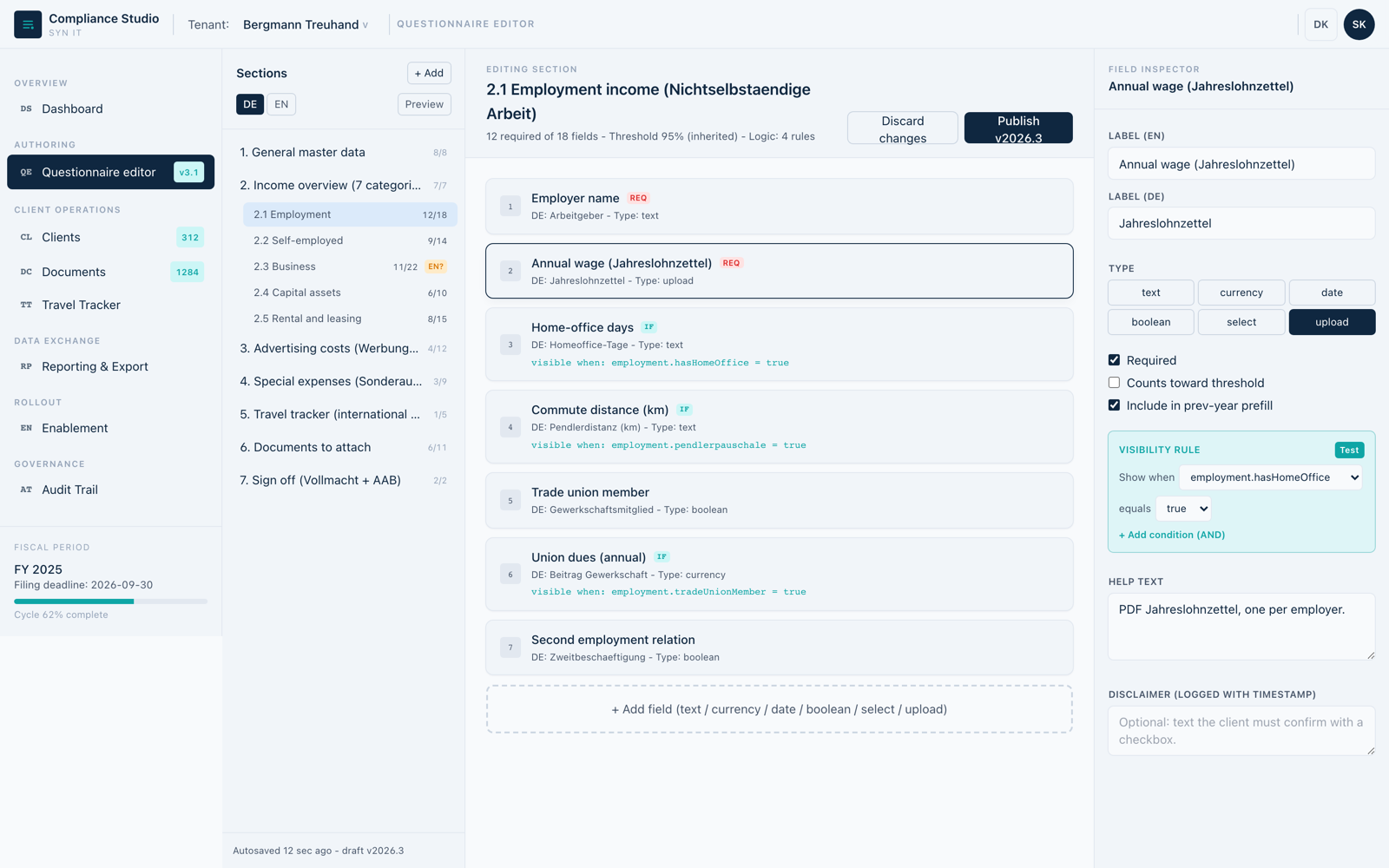
The firm publishes the questions. The client answers them in the browser, with the obvious mistakes caught while they are being made rather than three weeks later. Every answer is dated and kept with the version of the question it answered.
Documents attached to the answer they support
An upload belongs to the question it evidences, not to a shared folder. When somebody asks which paper supports a given figure, that is a click and not an afternoon.
A record that cannot be quietly rewritten
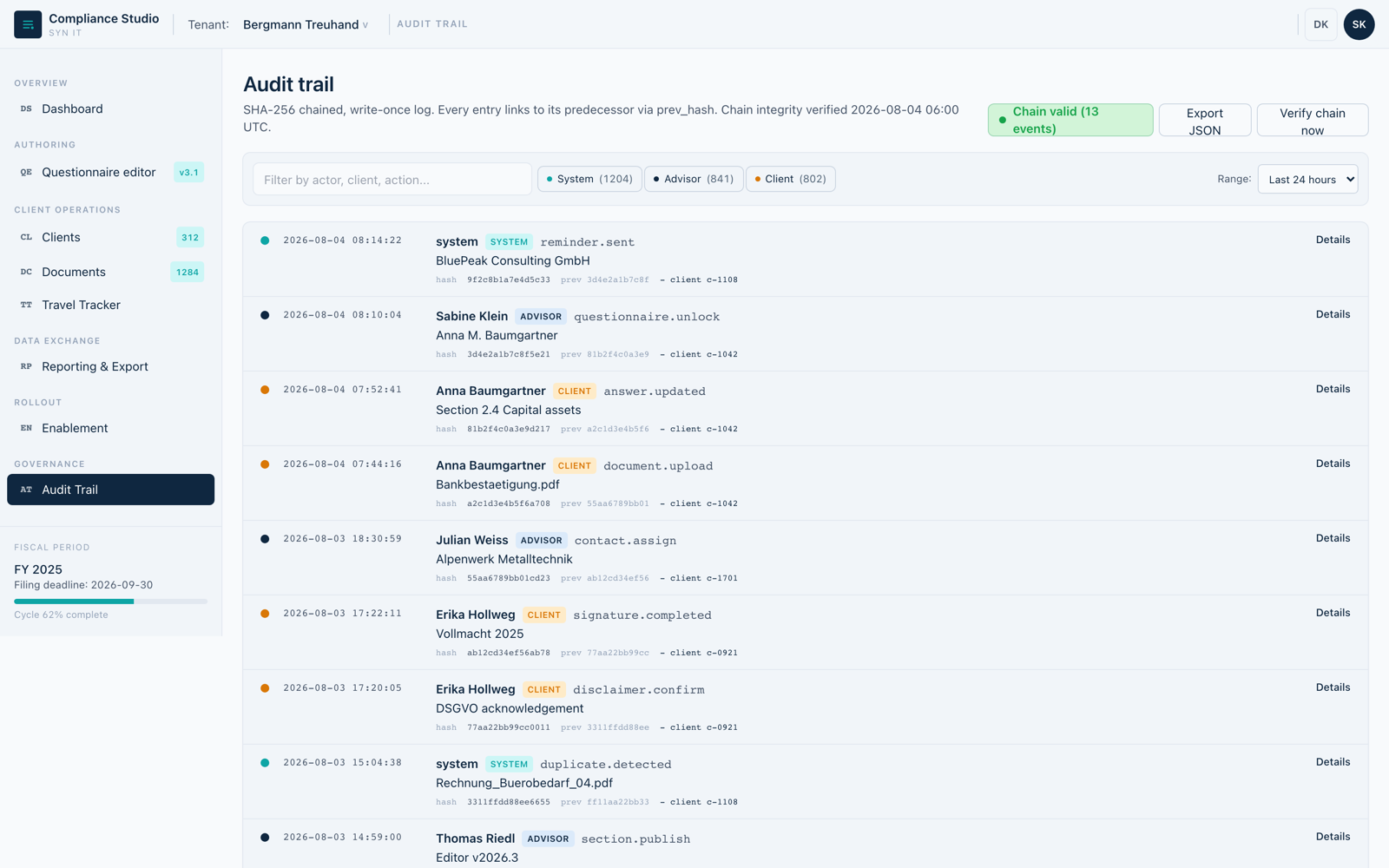
Every change is linked to the one before it, so editing something after the fact breaks the chain visibly instead of leaving no trace. What you show an inspector is what actually happened.
Assisted data entry, with a person still deciding
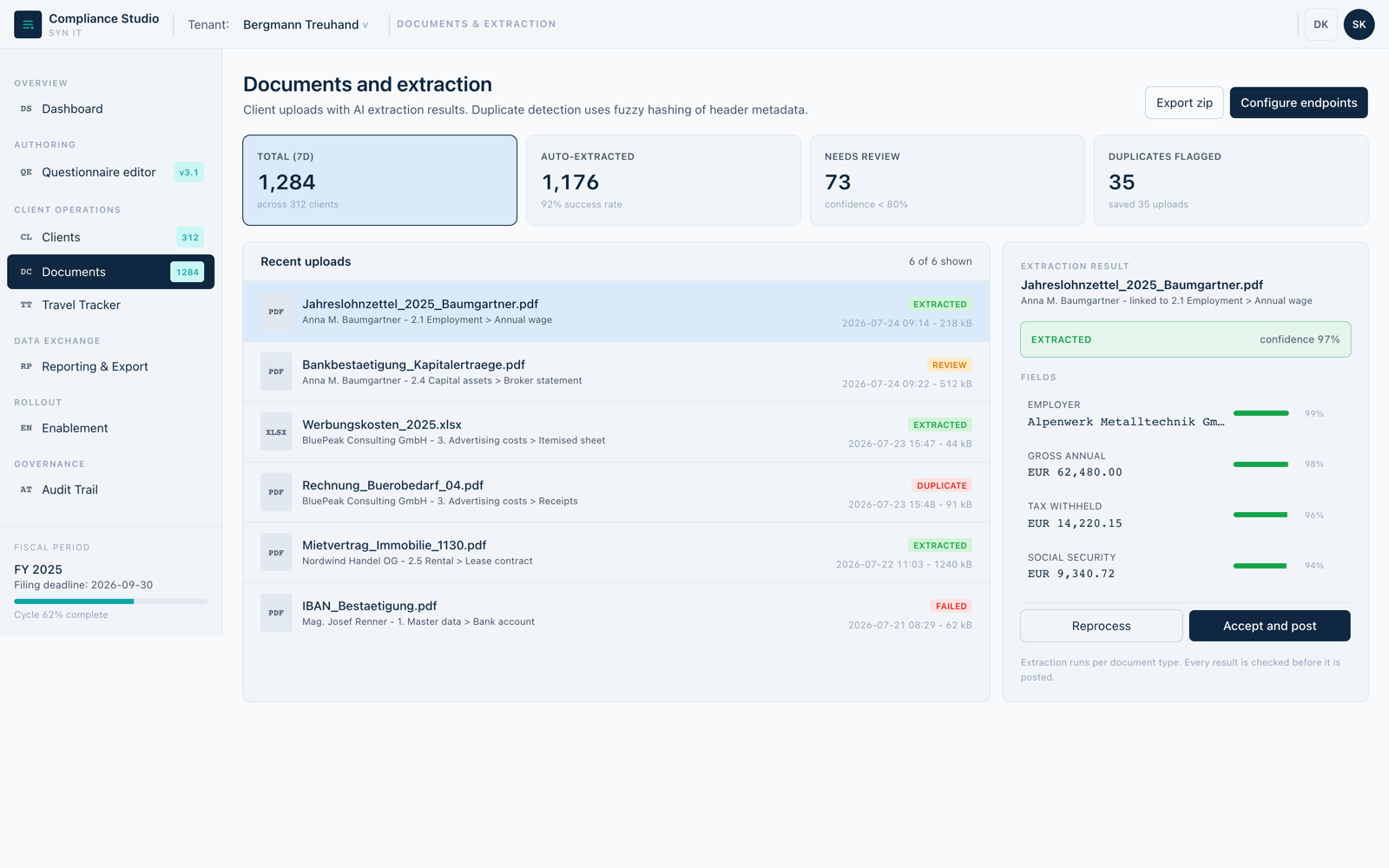
An uploaded document is read automatically and the values it suggests are presented next to it. Somebody accepts, corrects or rejects each one before it is part of the record. The work gets faster; the responsibility stays where it belongs.
You can see who is waiting on whom
One view of every open case: what is waiting on the client, what is waiting on the advisor, and what is running out of time. Chasing becomes a list rather than a memory exercise.
Travel and presence captured as it happens
The trips and days that a tax position depends on are recorded when they occur, in the same record as everything else, instead of being reconstructed from calendars at the end of the year.
What it is designed to do
Six connected surfaces, one case file.
Overview
The cockpit for the firm
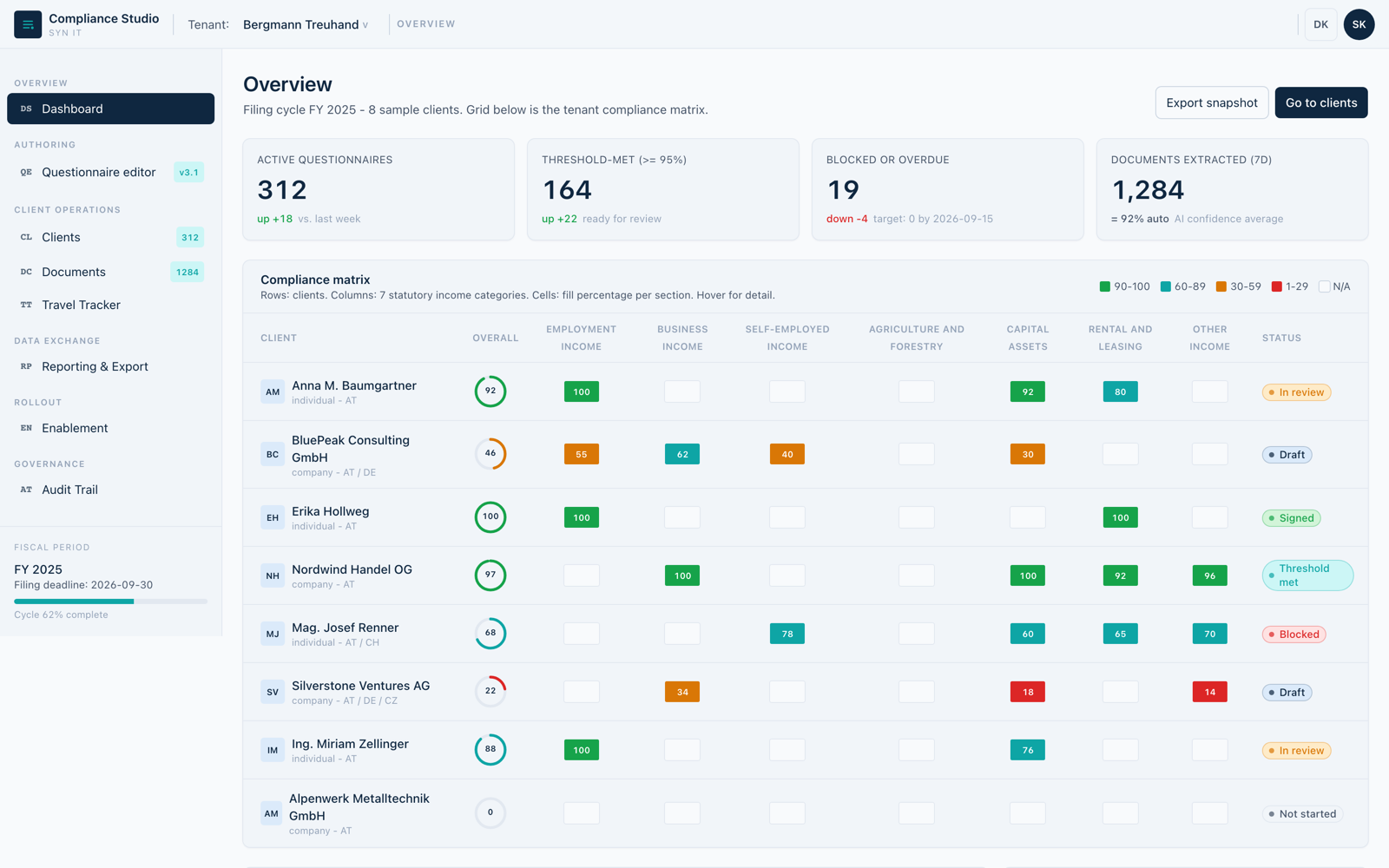
Open cases, what is waiting on a client, what is waiting internally, and the deadlines coming up. One screen instead of a shared mailbox and a spreadsheet.
Clients
One row per client, with the state of every case
Where each engagement stands, when it last moved, and what happens next. No separate tracker to keep in step.
Questionnaire
Sectioned, validated and versioned
Answers save as they go, so a long questionnaire survives being filled in across three sittings. Questions are versioned, so it is always clear which wording was answered.
Documents
Uploads with an extraction preview beside them
The document on one side, the values read out of it on the other, and a person deciding what goes into the record.
Record
A linked history rather than a change log
Each entry references the previous one, so the sequence is verifiable end to end and tampering shows up as a break rather than an absence.
Travel
Days and trips recorded as evidence
Captured against the same case file and the same history as everything else, so it stands up as part of the file.
How it looks
Designed, and ready to shape with you.
These are design screens, not a running installation. They exist so an early conversation is about something concrete: this is the shape we would build from, and the point of an early engagement is that you change it.
How an early engagement works
We start from your actual process: which questions you ask, which documents you need behind them, which deadlines drive the year. You get a system shaped around that and real influence over what the product becomes. It is a short, honest conversation first, so nobody spends money finding out it is not a fit.
Works with the rest of the range
It shares its sign-in and its look with the reporting products, so people move between the compliance file and the figures without a second account. The same record can be referenced from an automation that collects or files evidence on a schedule.
How to start
Talk to us before your next filing cycle.
Early engagements are limited and deliberately close. If the fit is wrong we will say so in the first conversation rather than after a procurement round.